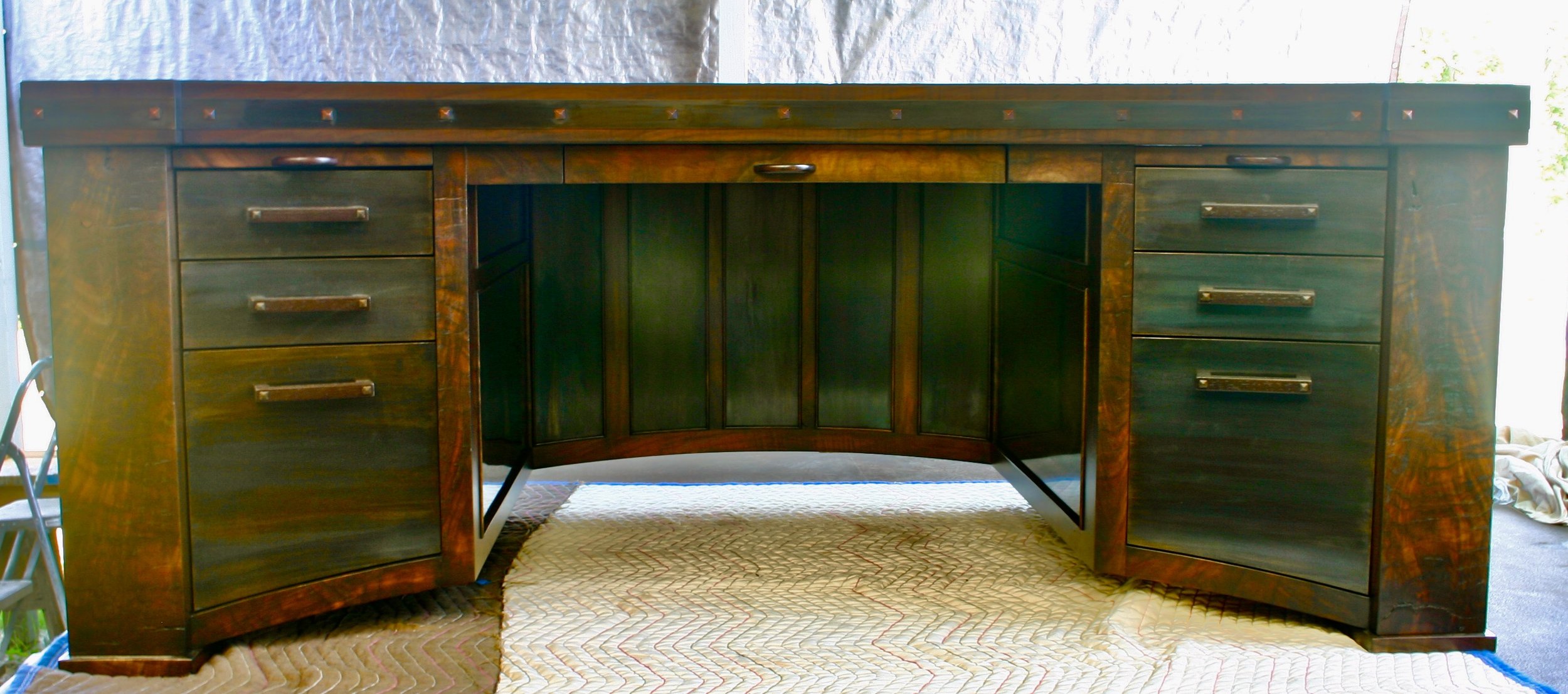
Whether you’re going to make something in wood or have someone make it for you, at some point you need to decide on the type of wood for color, texture, strength, etc. So, I am going to talk about some of the things you should consider when selecting the wood for color.
Wood is consistently changing color no matter what finish you apply. Clear finishes, especially, change color over time, but a heavily-pigmented stain or tint will change also. Direct sunlight has the most pronounced effect, but even rooms with only North-facing windows receive indirect light which will have an effect on color. The idea is not to pick a wood for it’s color when first milled, but for what it is going to look like in one, five, or ten years. Otherwise you might be very disappointed.
I can’t list every type of wood here, so I’ll give some general changes you should consider. Almost all tropical woods (woods growing close to the equator) become darker, even with direct sunlight. Some become very dark. Also, in some species, the degree of darkening will vary quite a bit from board to board. You may mill the wood, select color matches, and one or two years later the match is not even close. When matching different boards for color you need to select for color, texture, and density (weight) to make sure the color remains matched over time.
UV finishes will only slow this darkening and lightening process down between 10% and 50%, but not stop it. If the tropical wood piece is getting only indirect sunlight the wood will only darken. Most tropical woods have bright distinct colors when first milled, but as the darkening occurs, the purples, reds, pinks, and greens usually become less bright and more brown. Purple heart, for example, will be completely dark brown in a few years with no purple. Burmese teak, when first milled, is very light tan with pinks and greens. Within days the pinks and greens are gone leaving an even light brown, becoming more and more golden medium brown over time.
All woods change, and that is part of their beauty. Knowing what that change is going to be eliminates the surprise and allows you to enjoy this natural process.
In my next blog entry, I am going to talk about domestic hardwood color changes which are very different than tropical woods.
There are a number of different criteria I use to decide on the type of glue to use for different applications and I would like to talk a little bit about that in this blog. Exposure to the elements (inside or outside use), density and oil content, color, stability, and use of end product. Below is a partial list of common glues I have used in the past.
1. Plastic Resin (water and powder mix). This glue is too brittle and I don’t recommend using it for any circumstances.
2. Urac (powder and resin mix). A urea-formaldehyde glue. It’s very strong, has good gap filling qualities, and is good for exterior use. It comes in second place to Epoxy for oily/dense woods. Wear gloves and mask when mixing. I have replaced it’s use with Titebond III which has a very low toxicity level and is just as strong and versatile for interior use.
3. Gorilla Glue (urethane glue) is very strong but because of foaming I don’t use it when other glues are as strong and much easier to work with.
4. Resorcinol (powder and resin mix). This leaves a dark glue line, and has all the same good and bad qualities as urac. I use epoxy in its place now because of more versatility.
5. Epoxy (liquid hardener and resin). I mostly use West Systems for exterior use, dense oily woods, and in the vacuum press for bent laminations (epoxy doesn’t need air to cure). It is very toxic and care must be taken when using it.
6. Titebond III (yellow or tan, water clean-up) I use Titebond III by Franklin on interior and some protected exterior work. This glue is very strong, gap filling, #1 type water resistant, easy clean up, and low toxicity.
To sum up the above, I use two types of glues now. West Systems Epoxy on exterior heavy-exposure areas or where extra strength water resistance is needed, on dense and oily woods like teak and rosewood, and in vacuum press bent laminations. And Titebond III on interior work.
West Systems requires special pumps for mix ratios. You should apply an even coat of properly mixed hardener/resin, wait 10-15 minutes for it to soak into wood surfaces and then mix another batch of epoxy adding 20-30% by volume of colloidal silica to epoxy mix and again apply an even coat to both surfaces. Apply a light pressure with clamps, 5 to 10 lbs. Any more pressure will drastically reduce joint strength.
Another thing to remember - don’t use silicon lube on your machine surfaces, it will contaminate epoxies. Thoroughly mix epoxy. Different hardeners are available to lessen or lengthen open times. I buy West Systems at a local marine supply store. Clean up is with alcohol. Always wear gloves, it’s very toxic.
And, as I said before, I use Titebond III mostly on interior work. I don’t recommend its use for dense, oily woods. Being water resistant doesn’t hurt, especially on bath and kitchen work. It has a longer open time (about 30 minutes at 70 degrees Fahrenheit) which helps for the more complex glue ups. Apply an even coat to both surfaces and not too much pressure or you’ll weaken the joint, up to about 15 to 20 lbs. is good. Clean up is with water. Don’t forget to wear gloves, even though its a low-toxicity glue. This glue is a good choice where food will come into contact.
I hope I have explained the differences between glues, and you have a better understanding of the applications each type is used for.
When making solid wood furniture you will need to glue-up a number of pieces to width to make up any panels. Most hardwood lumber is not less than 4″ wide and not more than 14″ wide. Anything wider has become more and more rare.
I recently bought two Bubinga planks, 2″ thick x 42″ wide x 14′ long, with live edges. I can usually find woods like Cherry, Walnut, and Mahogany up to 36″ wide but these are not common sizes and take a lot of research, and I pay a premium price for that large width. So most work will require some glue-ups.
There are a number of different joining methods and all require glue. Butt, dowell, and biscuit joining are the most common today. Also used are splines, through bolting and glue joints.
I am going to start by explaining the worst joining methods and progressing to the best ones and explain their advantages and disadvantages.
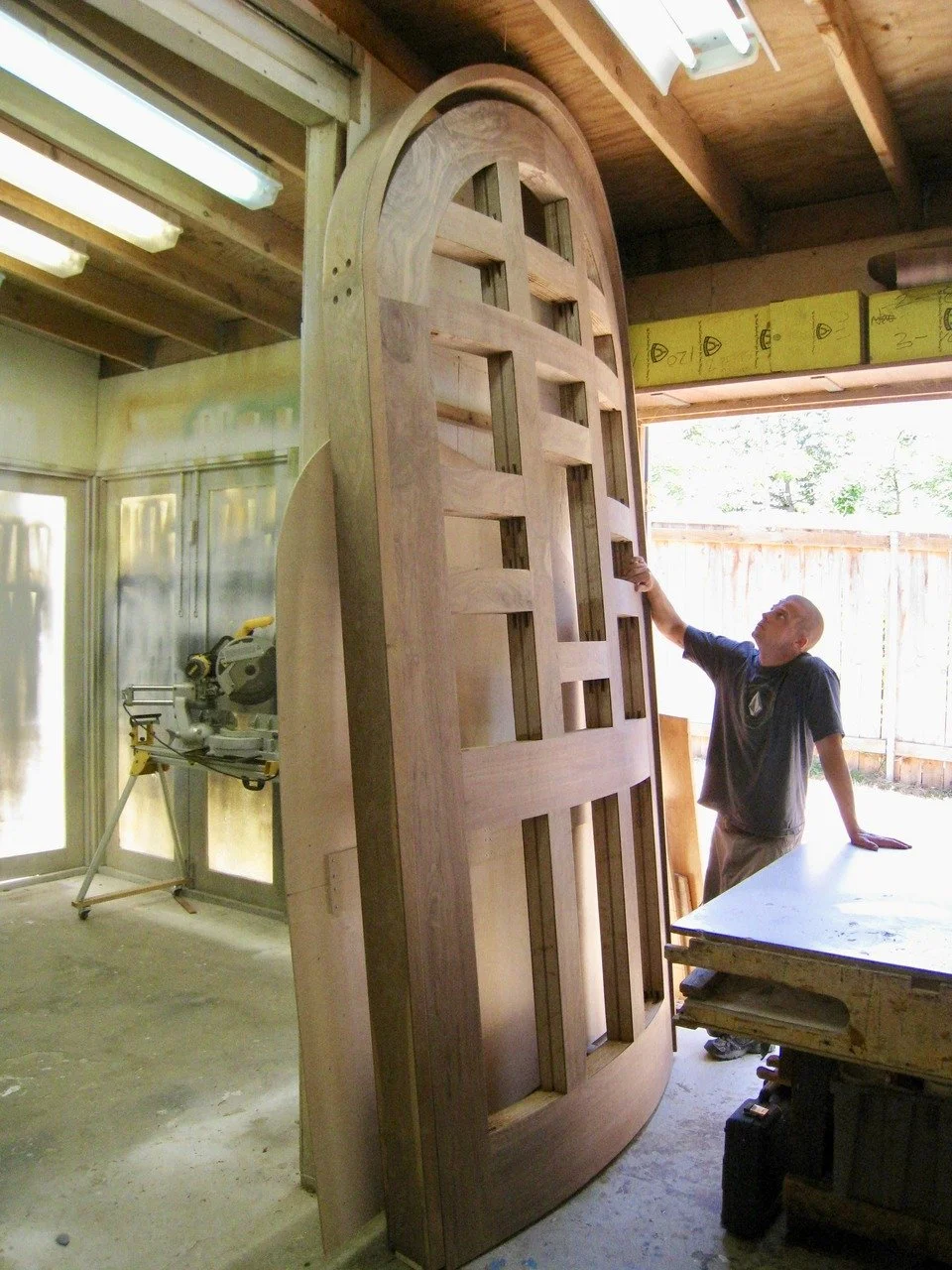
1. Through bolting is usually used in thicker glue-ups (2″ and greater) when making cutting boards and slab doors, for example. It is actually worse than doing no joinery at all. Boards are drilled through their width and all-thread is inserted through the holes, washers and nuts placed on both ends and tightened. Sounds strong, right? Well, it is strong, except for the problem that wood is always changing dimensions. Higher humidity expands wood, lower humidity shrinks it. Ten years after your glue-up the panel will still be changing dimensions with the seasons. So when the panel expands against the tightened bolts, the panel warps because it has no where to go. And when the panel shrinks, the bolts are doing nothing. So what you have is a butt jointed panel which will eventually fail.
2. In butt jointing you are joining pieces with glue only. With softer, more porous wood, and using all the proper glue-up techniques, it’s pretty strong because of our modern glues. But over time, some joints will starts to fail. With hard wood, and especially hard oily wood, the failure rate becomes higher and can be quite severe.
3. Splines are grooves cut in the edges of the boards to be glued up. A plywood or solid-wood spline is cut slightly smaller than the depth of the two grooves combined, for the glue to squeeze out. Glue is placed on all surfaces and clamped up. The glue space creates a weakness in the joint, making the joint 20% to 30% weaker than the solid wood itself. All joinery should strive for a joint that is as strong as the wood itself, or stronger.
4. Both dowels and biscuits are very similar in strength but they use just slightly different techniques. They both interlock the joint and add glue surface that butt joints lack, without causing a weakness like splines. But they should not be used in large glue-ups or in exterior doors because of the stress.
5. Glue joints are usually run with a shaper but can be run with a router as well. It’s a single cutter that is offset allowing for a single set-up as opposed to a tongue-and-groove set-up requiring two cutters and two set-ups. What a glue joint does is interlock the joint and double the glue surface, making this joint the strongest in any type of wood and without any of the drawbacks of the other joints.
As outlined above, #5, glue joints, are the best way overall when constructing solid wood panel joinery. The other methods are widely used, but should be used with caution, and only in certain applications. Furniture and doors should be built to last a couple of lifetimes, in my opinion, and if you build it right, it will.
Let’s talk about plywood now that MDF is never going to be used again in your furniture projects. Plywood is made of solid wood strips glued up in width, with two or more veneer layers on both faces (lumber core) or multiple veneer layers with every other layer 90 degrees to the above layer. The layers vary from roughly 1/4″ to 1/16″ thick and 5 to 15 layers of hard or soft wood with one layer of more or less finished veneer on both faces, depending on the grade (veneer core)
The positive attributes of plywood, especially lumber core, and Baltic birch or apple ply (both usually 15 layers of hardwood) are it is relatively light, strong and fasteners, joinery and glue-ups work pretty good. Also, there is not much dimension change with an increase or decrease in humidity.
The disadvantages of plywood are the surfaces, and especially the edges, which damage easily. Also, if you want to use solid wood and plywood together, they are difficult to match finishes, because the cut of the veneer produces different grain patterns and solid wood oxidizes differently than veneered surfaces that are only 1/60″ to 1/30″ thick.
Solid woods like cherry and mahogany get quite a bit darker as they age, while walnut becomes lighter, kind of a golden brown. Veneered plywood changes very little, the change being hardly noticeable.
My conclusion has been if I am going to use plywood in a project, it is only used on the interior of a project, such as division walls, bottoms, backs, etc. All exterior frames, panels, doors, drawers, including drawer sides and all shelving are solid wood. This combines the strength and ease of working in plywood on the interior parts of the project, and the furability and beauty of solid wood on the exterior and other areas of the project, where wear is a concern. Note: Don’t use plywood for any shelving, especially adjustable shelving. Over time, plywood will sag. Solid wood can be repaired and refinished over and over, giving it longivity other materials don’t have. One other concern is to be careful when combining solid wood and plywood because of the difference in expansion and contraction, which I will go into more in the future.
I know that most of the world is adopting MDF in it’s various forms as the accepted standard but it is NOT because it’s better. Furniture and case goods made from MDF will last about one tenth to one quarter as long as medium to well-made solid wood furniture and case goods. MDF manufacturing produces more toxic waste than solid woods, even with the better glues being adopted in California. The short life span of MDF furniture and case goods means that it ends up in land fills polluting in ever-increasing amounts, instead of reusing the furniture as has been done with well-made antiques for hundreds of years.
The ONLY reason MDF is used is because it is cheap and the construction techniques used with MDF are simple to learn, so that less-experienced workers are needed.
In my next blog, I will talk about the use of plywood in furniture.